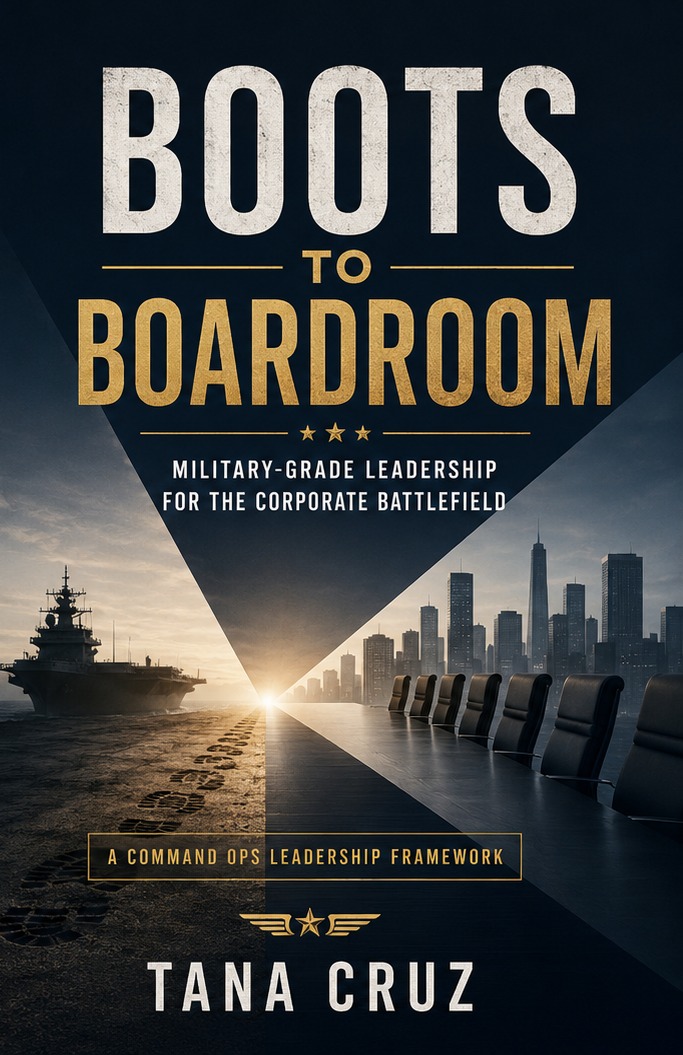
Military-Grade Leadership for the Corporate Battlefield
The chaos in your organization isn't a people problem. It's an architecture problem. I spent years in the U.S. Navy learning how to build systems that perform when everything is on the line — then spent more years watching corporate leadership fail for the exact reasons the military never does. This book closes that gap.
Not theory. Not motivation. Three field-tested frameworks translated directly from military command into civilian leadership — each building on the one before it.
Before you fix anything, you have to see it clearly. INTEL & RECON™ maps the structural failures hiding beneath surface symptoms — chaos, imprecision, accountability gaps — so you can design around what's actually broken.
Design decision authority, communication, and accountability as infrastructure — not personality. SYSTEM COMMAND ARCHITECTURE™ turns your leadership presence into a structural element that stabilizes the organization even when you're not in the room.
Deploy your systems into the real world — volatile, political, high-stakes. DEPLOYMENT & FIELD INTEGRATION™ builds the endurance, readiness, and political intelligence required to sustain performance under pressure and build something that outlasts you.
Every chapter includes a real case study, an audit framework you can run in your own organization, and doctrine you can apply the same week.
Define ownership, set speed expectations, classify reversibility, and normalize course-correction — so decisions stick the first time.
The BLUF method, command intent, and the three-purpose filter that eliminates communication waste and produces execution-ready clarity.
The five-step Accountability Loop Review adapted from military after-action reviews — structured, consistent, and psychologically safe.
Stakeholder mapping, narrative ownership, strategic visibility, and boundary enforcement — the tools of aware leadership.
Load shedding, rhythm enforcement, backup activation, and the structural design that sustains high performance without burning your best people out.
Decision codification, cultural translation, authority distribution, and successor readiness — the four pillars of institutional leadership.
I joined the U.S. Navy at twenty-five because the 2008 financial crisis showed me what happens when systems fail and people have nothing to fall back on. The Navy gave me what no MBA could — discipline, accountability, and the architecture of high-performance under pressure.
When I returned to corporate environments, I brought those frameworks with me. I became Chief of Staff to the CEO of a global financial firm managing $2B in equity. I navigated transformation at a $40B pharmaceutical company. I watched brilliant organizations fail for reasons the military solved decades ago.
That's why I built Command Ops — and why I wrote this book.
This isn't a leadership book. It's a field manual. I used the accountability frameworks in Chapter Three in the same week I read them — and my leadership team noticed the difference immediately.
I've read every major leadership book in the last decade. This is the first one that treats organizational dysfunction as an architecture problem rather than a culture problem. That distinction alone is worth ten times the price.
The section on decision authority changed how I run my entire organization. We had smart, talented people making zero decisions because nobody knew who actually owned the call. That's fixed now.
Choose the format that works for your mission. Every edition includes the full framework, all twelve case studies, and every leadership doctrine and audit tool in the book.
Enter your email and receive a Chapter — Orders, Not Chaos — instantly, plus updates on workshops, speaking events, and new releases from Command Ops.
No spam. No selling your data. Just leadership doctrine worth reading.